
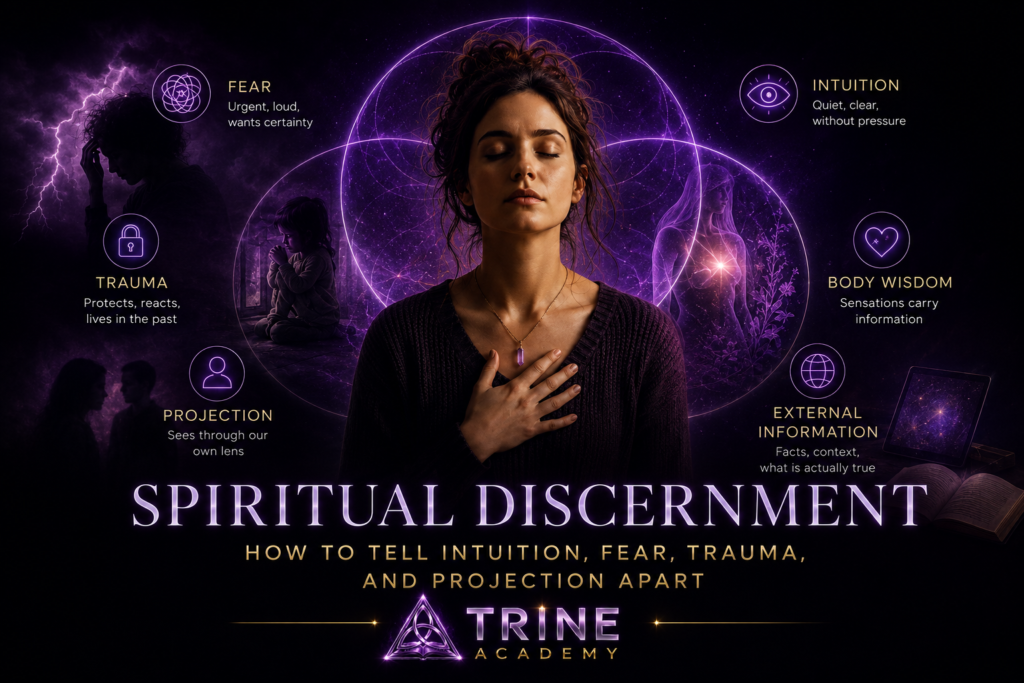
How to Tell Intuition from Fear, Trauma, and Projection Apart

TLDR; Intuition typically arrives as information first. Fear typically arrives as emotion first, followed by a psychological story about what might be wrong. Spiritual discernment is learning to separate the original information from fear, trauma, projection, and interpretation.
how to tell intuition from fear, anxiety and trauma response

How to Tell Intuition From Fear

One of the questions I hear over and over is some version of, “How do I know if this is my intuition or if I’m just afraid?”

That question matters because fear can be incredibly convincing. Fear does not politely knock on the door and announce itself as an emotional response. It shows up, kicks the door in, turns on every light in the house, and starts presenting evidence.

Imagine you are sitting on the couch doing absolutely nothing dramatic. Suddenly, you feel an intense wave of fear. Within seconds your mind starts running: Something happened to my husband. Are my kids okay? I should call them. Why am I feeling this? Something has to be wrong.

Five minutes later, your logical brain has somehow produced a full emergency response plan, three possible catastrophes, and possibly a funeral itinerary. That is fear doing what fear does. A sensation or emotion appears, and the psychological mind begins searching for a reason.

Psychic perception behaves differently in my experience.

Information arrives.

Sometimes it is useful. Sometimes it is weird. Sometimes it is specific enough that I immediately know what I am looking at. Sometimes I have no clue what the information means until later. There can be an emotional reaction to the information, especially if what comes through is upsetting, but the information and my reaction to it are two separate events.

That distinction is the beginning of spiritual discernment.

Spiritual Discernment Is About Identifying What You Are Experiencing

I have spent a lot of time paying attention to how information comes through me, both privately and through deliberate intuition tests where I could later compare what I perceived against actual information. I have also watched these distinctions play out with clients, friends, and people trying to make sense of their own perception.

What becomes obvious after enough observation is that several completely different experiences can get lumped together under the word intuition.

  • A person feels afraid and calls it intuition.
  • A trauma trigger fires and gets interpreted as a warning.
  • Someone desperately wants a relationship to work and begins reading every coincidence as confirmation.
  • A psychic impression comes through and then the person’s logical mind immediately begins trying to explain it.

The first useful question is therefore very simple:

What happened first?

That question sounds almost insultingly basic until you actually use it.

  • Did information arrive first?
  • Did fear arrive first?
  • Did your body react first?
  • Did you see, hear, know, sense, or perceive something before the emotion appeared?
  • Or did an emotional state appear and then your mind begin looking for an explanation?

Sequence matters.

What Psychic Perception Feels Like in Real Life

There is a tendency to make psychic perception sound dramatic, which I find mildly hilarious because plenty of it is aggressively ordinary. Sometimes I am talking to someone and information simply starts coming through. There is no choir of angels. The ceiling does not open. Nobody hands me a glowing scroll.

The information is simply there.

Depending on how someone perceives psychically, that information may appear as knowing, images, words, sensations, impressions, emotional information, or something that is harder to translate into language. Different psychic senses behave differently, and people often have more than one.

What matters for discernment is the quality of the information before the thinking mind starts doing arts and crafts with it. The original perception can be surprisingly clean. Then the human part gets involved.

We begin interpreting it, comparing it with previous experiences, deciding what it means, wondering what we should do about it, and occasionally building an entire Netflix limited series around six seconds of information. That second part deserves attention because interpretation can change the meaning of what was originally perceived.

Fear Creates a Story

Fear is psychological, and psychology loves narrative. The emotion appears, and the brain wants a reason. Human beings are deeply uncomfortable with unexplained internal experiences, so the logical mind begins searching the environment for something that makes the fear make sense.

This is why someone can suddenly feel afraid and immediately begin thinking about everyone they love.

  • Is my husband okay?
  • Did something happen to my daughter?
  • Why hasn’t my son called me?
  • I knew something was wrong.

Except nothing has happened yet. The fear came first. The story came second. When you are trying to tell intuition from fear, ask:

What actual information did I receive before I became afraid?

That question can stop the whole process long enough to see what is happening.

If the answer is, “I didn’t receive anything. I suddenly felt terrified and then started imagining everything that could be wrong,” you have useful information.

The fear itself is real. The catastrophe your mind produced to explain it is still a hypothesis.

And this is where spiritual discernment requires enough self-awareness to avoid treating every emotionally intense experience like a breaking-news alert from the psychic realm.

Intuitive Information Can Create Fear Afterward

Here is where things become more nuanced. Psychic perception can absolutely be followed by fear. You may perceive something unsettling. Then your emotional system reacts to what you perceived. That sequence looks very different.

For example, information comes through that makes you concerned about a situation. You register the information, understand enough of it to recognize that it could be serious, and then fear appears.

Now the fear is a response to information. That distinction matters because people often assume that the presence of fear automatically disqualifies intuition. In lived experience, things are rarely that tidy.

The useful question remains:

Which came first: information or fear?

Then ask:

What was the information before I started interpreting it?

Those two questions can separate a surprising amount of noise.

Where Trauma Enters the Picture

Trauma adds another layer because previous experiences affect how we respond to current ones. If you have lived through betrayal, abandonment, instability, manipulation, violence, emotional unpredictability, or any situation where you had to become highly aware of other people’s behavior, you may react quickly when something in the present resembles the past.

That reaction can happen before you consciously understand why. There is also an uncomfortable reality here that gets flattened in both spiritual and psychological conversations: trauma can make someone highly observant.

If you spent years needing to notice tiny changes in tone, posture, mood, behavior, or environmental conditions because those changes mattered, you may become extremely good at seeing things other people miss.

The complication is interpretation. You may accurately notice a change and then interpret that change through an old experience. Someone becomes quieter. You pick up the shift immediately. That perception may be accurate. Then the old pattern enters: They’re angry. I did something. They’re going to leave. I need to fix this.

Now several things are happening at once. You noticed something. Your history gave the change meaning. Your emotional system reacted. And your mind began predicting the future.

Spiritual discernment means separating those layers instead of arguing over whether the whole experience belongs in either the “intuition” box or the “trauma” box.

Ask the Logical Brain Better Questions

The logical mind gets blamed for interfering with intuition all the time, but I actually think that wastes a perfectly useful tool. The problem is rarely that you have a logical brain. The problem is what you ask it to do.

If you tell your brain, “Something is wrong. Figure out what,” congratulations, you have just assigned an anxious intern a murder investigation. It will find something. A more useful approach is asking questions that help you examine the experience without forcing an answer.

  • What happened first?
  • What did I actually perceive?
  • What emotion appeared?
  • What meaning did I add?
  • What facts do I currently have?
  • What part of this am I assuming?
  • Have I experienced this particular feeling before?
  • What usually happens when I feel this way?
  • Am I attached to a specific outcome?
  • What am I afraid will happen?
  • What do I want to happen?

Those questions give the logical brain a different job. Instead of manufacturing certainty, it helps you sort information. That is far more useful.

Projection Can Sound Extremely Spiritual

Projection gets particularly entertaining in relationships because emotional attachment can turn otherwise intelligent adults into unpaid detectives. You feel something strongly about another person. Maybe there is attraction, fear, grief, hope, anger, longing, or a complicated connection you are still trying to understand.

Then something happens. They post a song. They use a certain phrase. They disappear for a day. You dream about them. A particular number appears. Suddenly, everything becomes evidence.

This is where projection can begin masquerading as intuitive certainty. Projection adds your own internal material to what you are perceiving. You may pick up something real while simultaneously assigning your own explanation to it.

For example, you may accurately perceive that someone has emotionally pulled back.

That perception says: something changed.

Projection may say: they pulled back because they are scared of how strongly they feel about me.

Fear may say: they pulled back because they are about to abandon me.

Desire may say: they are processing the intensity of our spiritual connection.

Meanwhile, the person may simply have the flu. Discernment lives in the space between “something changed” and the twelve-paragraph explanation for why.

Desire Deserves Just as Much Attention as Fear

People are usually willing to question their fear. They are considerably less enthusiastic about questioning what they want. Desire can create very persuasive interpretations because the desired conclusion feels good. If you desperately want a relationship to mean something, you become more likely to interpret ambiguous experiences in that direction.

If you desperately want a business opportunity to work, every positive sign starts feeling significant. If you want confirmation that you are on the right path, ordinary coincidences can become very emotionally charged.

Again, the experience itself may still contain meaningful information. The useful question is:

What would I think this meant if I wanted a completely different outcome?

That question is rude. I recommend it anyway.

Another useful question is:

What information would change my interpretation?

If the answer is “nothing,” you are no longer examining information. You are protecting a conclusion.

Learn the Difference Between Information and Interpretation

This may be the most important skill in the entire process. Information is what came through. Interpretation is what you think the information means. Those two things can happen so quickly that they feel identical.

Say you suddenly know that you should check on someone. That is information. Then you think: Something terrible happened. That is interpretation. You contact them and discover they are going through a difficult emotional situation. Now you have additional information.

Your original perception may have been accurate while your first interpretation was more dramatic than reality. This happens. The psychic information does not have to be wrong for the interpretation to be wrong.

And frankly, once you accept that distinction, psychic development becomes considerably less exhausting because you stop expecting yourself to instantaneously understand every piece of information that crosses your awareness.

Sometimes you perceive something before you have the context required to interpret it. Put it on the shelf. The shelf is free.

Spiritual Discernment Gets Better When You Track Yourself

One of the most useful things I have done with psychic perception is test it. When you track information before you know the answer, you remove a lot of the bullshit humans are exceptionally good at introducing after the fact.

  • Write down what you perceive.
  • Write down exactly what came through before you start explaining it.
  • Then compare it with what you later learn.
  • Over time, you begin seeing patterns in your own perception.

You learn what clean information feels like for you. You learn what fear feels like. You learn what happens when you are emotionally attached. You learn which psychic senses you use most easily and which ones require more interpretation. You also learn where you tend to screw yourself up.

That part is useful too.

Maybe you perceive people very clearly until you are romantically interested in them. Suddenly your accuracy packs a suitcase and moves to another state. Maybe you receive clear information but habitually add an interpretation that turns out to be wrong.

Maybe fear creates a specific physical pattern you begin recognizing immediately. Maybe your strongest psychic perceptions feel emotionally neutral until your mind understands what they mean. These patterns become visible because you have actual lived evidence to compare.

What About Nervous System Responses?

The nervous system matters because you have a body and, inconveniently, it insists on participating in your experiences. You can perceive something psychically and then have a physical response. You can experience fear and have a physical response.

You can encounter a trauma trigger and have a physical response. You can become excited, angry, attracted, overwhelmed, exhausted, or overstimulated and have a physical response. The physical reaction tells you that something is happening in your system. Context tells you more about what that something may be.

This is another reason I pay attention to sequence.

  • Did I perceive information and then my body reacted?
  • Did my body suddenly react and then my mind began searching for meaning?
  • Did an external event trigger a known emotional pattern?
  • Did the physical response resemble something I have experienced repeatedly in similar situations?

Instead of treating the nervous system as the origin of every experience, I find it far more useful to look at how it responds to the experience. That gives us another layer of information without forcing every phenomenon into the same explanation.

The Difference Between Discernment and Doubting Yourself

There is a point where discernment can turn into compulsive self-questioning. That is hardly useful either. If every psychic impression is followed by twenty minutes of cross-examination, you eventually become so busy interrogating yourself that you cannot hear anything clearly.

Discernment gets easier when it becomes observational. You receive something. You notice it. You identify your emotional response. You separate the original information from the interpretation. You check for fear, projection, trauma patterns, and attachment where relevant. Then you continue gathering information. You do not need to put every intuitive impression through a federal appeals process.

The goal is clarity.

When You Simply Do Not Know What Something Means Yet

One of the most useful answers in intuitive work is also the one people seem least willing to use:

I don’t know yet.

You can perceive something clearly and have no idea what it refers to. You can feel a shift around someone and lack the context to explain it. You can receive a symbol that makes absolutely no sense. You can know something changed without knowing why.

Trying to force an interpretation because uncertainty feels uncomfortable usually creates more noise. Sometimes the meaning becomes obvious five minutes later. Sometimes it takes months. Sometimes you never get enough information to understand it completely.

Human beings have survived worse tragedies than an unanswered psychic impression. Let it breathe.

A Practical Spiritual Discernment Check

When an experience feels significant, start with the original event and work outward.

Ask yourself:

  • What happened immediately before this?
  • What was the very first thing I experienced?
  • Did information arrive, or did an emotion arrive?
  • What exactly did I perceive before I interpreted it?
  • What did my mind add afterward?
  • What emotion am I experiencing now?
  • Does this resemble a familiar fear or trauma pattern?
  • Am I emotionally attached to a particular explanation?
  • What facts support my interpretation?
  • What other explanations could fit the same information?
  • Can I wait for more information before deciding what this means?

These questions bring the logical brain into the process without asking it to explain away the experience. The point is to get cleaner.

Spiritual Discernment Comes From Knowing Your Own Perception

There is no universal chart that tells everyone exactly how intuition feels, how fear feels, how trauma feels, and where projection enters. You learn through experience. You pay attention to yourself. You test what can be tested.

You compare what you perceived with what eventually happened. You become familiar with your own fear patterns, your own psychological habits, your own emotional attachments, and your own psychic senses. Eventually, you begin recognizing the difference much faster.

Fear has a familiar flavor. Projection has one too. So does attachment. So does clean information.

The point of spiritual discernment is therefore much bigger than learning how to tell intuition from fear. You are learning how to identify what is moving through your awareness before your mind turns the whole thing into a story.

  • Sometimes information comes through cleanly.
  • Sometimes fear grabs the microphone.
  • Sometimes trauma supplies the script.
  • Sometimes projection decides it is directing the movie.
  • And sometimes several of them show up at once because apparently the human experience needed additional difficulty settings.

The work is learning who is speaking.

Frequently Asked Questions

How can I tell intuition from fear?

Start with sequence. Ask what happened first. Fear often arrives as an emotional state and then generates thoughts about what might be wrong. Intuitive or psychic perception can arrive as information before the emotional reaction begins. Pay attention to the original experience before your mind starts interpreting it.

Can fear feel like intuition?

Yes. Fear can feel immediate, physical, and convincing. Once fear appears, the mind often searches for an explanation, which can create thoughts that feel significant simply because they carry emotional intensity. Looking at what information existed before the fear began can help you separate the two.

Can psychic information make me afraid?

Yes. Information can come through first and create fear afterward, particularly when the information is disturbing or personally significant. In that situation, separate the original perception from the emotional reaction that followed it.

Can trauma affect spiritual discernment?

Trauma can influence how you interpret current experiences and how strongly you react to certain cues. You may accurately perceive a change while your history shapes the story you attach to it. Learning your recurring trauma patterns helps you identify where perception ends and old interpretation begins.

Can projection feel like intuition?

Projection can feel extremely convincing, especially when you are emotionally invested in another person or outcome. The perception may contain accurate information while the explanation reflects your own hope, fear, attachment, or expectation.

How can I develop stronger spiritual discernment?

Track your experiences. Write down what you perceived before the outcome is known, record your emotional state and interpretation, and compare your notes with what eventually happened. Repeated observation teaches you how your own psychic perception, fear, projection, and emotional responses behave.

Does intuition always feel calm?

People experience psychic and intuitive information differently, and the content of the information can also create an emotional response. Instead of relying on a universal rule about how intuition should feel, learn the recurring patterns in your own perception and pay attention to what arrived first.

What should I do when I cannot interpret an intuitive impression?

Record the original information and leave the interpretation open. Additional context may arrive later. Discernment includes the ability to hold information without forcing yourself to decide what it means immediately.

Continue the Conversation Inside Trine Academy

Inside Trine Academy, we explore intuition and psychic perception through lived experience, observation, testing, discussion, and the uncomfortable questions that tend to get skipped when someone is trying to squeeze every spiritual experience into a tidy explanation.

We talk about psychic senses, energetic perception, nervous system responses, trauma, healing, metaphysical experiences, spiritual development, and the very human mess that happens when all of those things intersect.

If you are trying to understand how your own perception works instead of simply being handed another set of rules about what you are supposed to feel, join us inside Trine Academy.